
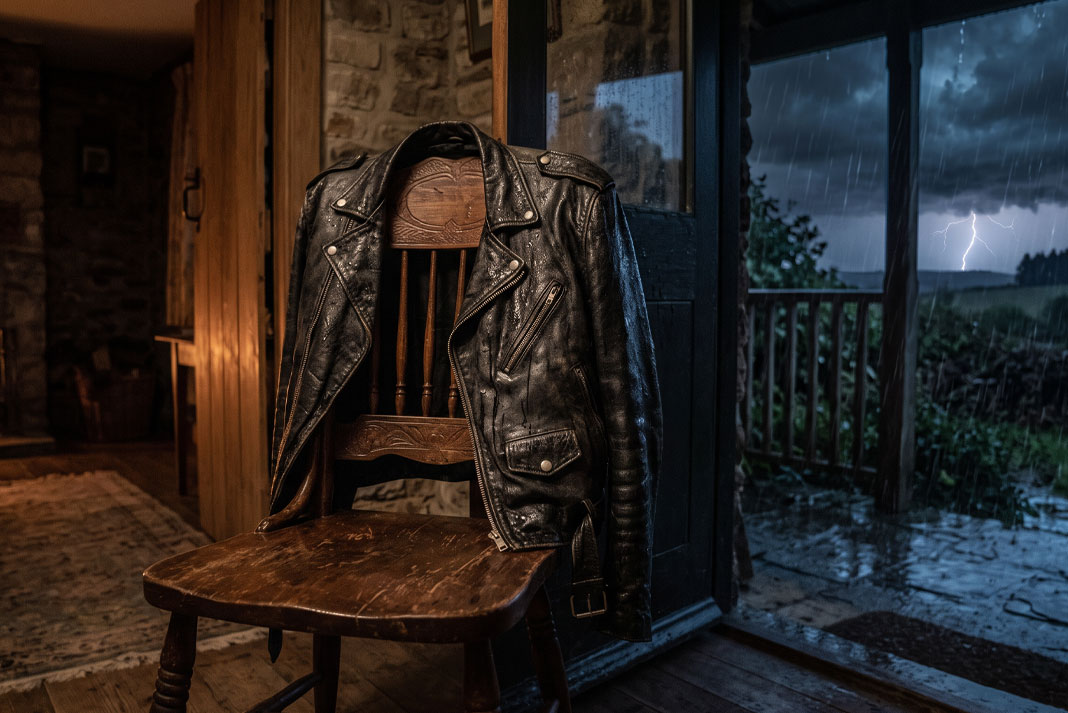

Some songs pick their central image and build outward from it. This one started with three words: cold, rain, leather. Everything else came after.
There’s a whole lineage of rain-as-heartbreak songs in this genre — Whitesnake’s “Crying in the Rain” is probably the most famous version of the idea, rain doing double duty as both literal weather and a stand-in for everything a person can’t stop feeling. Cold Rain on Black Leather leans into that same tradition, but narrows it down to one physical object instead of the weather alone — a leather jacket, left on a chair, getting rained on through an open door. That’s a smaller, stranger image than “rain equals sadness,” and it’s the reason the hook doesn’t feel recycled even though the underlying idea isn’t new.
The verses do something worth noticing: neither one blames the other person directly. “I was a fool to think I’d ever hold you down” puts the failure on him, not on her leaving. That’s a harder line to write than a betrayal narrative, because there’s no villain to be angry at — just a guy sitting with his own part in it. The vocal has to carry that kind of admission without over-explaining it, which is why the delivery stays raspy and controlled rather than going full power-belt too early. Save the belting for when the song’s actually ready to explode.
That explosion is the bridge — heavy bassline, crashing power chords, and the hardest question in the whole song: how is a person supposed to survive losing the one thing that mattered. From there, the guitar solo isn’t decoration, it’s the emotional release valve the lyrics never quite give themselves permission to be. Whammy-bar bends built to sound like actual crying, pinch harmonics screaming over the drums — the solo says the thing the verses were too guarded to say outright.
Then it just… stops. Single clean guitar note, rain sound effect, nothing resolved. A lot of writers would’ve wanted an ending that offers some comfort. This one doesn’t, because the whole song is about a version of grief that doesn’t get a tidy answer — just a man standing in a doorway, still there, still soaked, at the end exactly like he was at the start.